
Is Tae Kwon Do Good for Kids with Anxiety?
How structure, confidence-building, and physical activity help children manage anxiety and grow
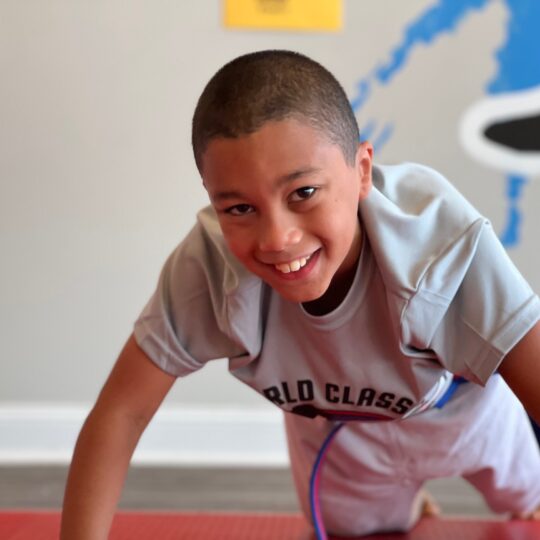
Anxiety in children looks different than most people expect. It isn’t always the child who cries before school or refuses to go to birthday parties. Sometimes it’s the child who seems fine on the outside but lies awake worrying. The one who avoids new situations or new people. The one who gives up quickly when something feels hard, not because they don’t care, but because the fear of failing feels overwhelming.
Parents looking for ways to help their anxious child often land in the same place — they want something that builds confidence, creates structure, and gives their child a safe place to grow without pressure. For many parents, what they’re looking for is Tae Kwon Do.
What Anxiety Actually Does to a Child
Anxiety, at its core, is the nervous system responding to perceived threat. For children, those threats are rarely physical — they’re social, academic, and situational. The first day of a new class. Being called on in front of others. Trying something and not being immediately good at it.
One of the most damaging things anxiety does is narrow a child’s world. It teaches them that certain situations are dangerous, that failure is catastrophic, and that the safest choice is avoidance. Over time, avoidance becomes a habit, and the habit makes anxiety stronger.
What anxious children need — what actually interrupts that cycle — is repeated, supported experience with doing hard things and surviving them. Not being told they can do it. Actually doing it, again and again, in an environment where it’s safe to struggle.
Why the Structure of Martial Arts Helps
Tae Kwon Do classes are built around a progression that is predictable, visible, and achievable. Every student enters at the same place. Every belt represents skills that were earned through practice. The path forward is clear, and so is what it takes to get there.
For an anxious child, that clarity is genuinely therapeutic. Anxiety thrives in uncertainty — in situations where the rules are unclear, where expectations are vague, and where failure feels random. A structured martial arts environment removes much of that uncertainty. You come to class. You learn specific skills. You practice them until they become second nature. You test when you’re ready. You advance.
That predictability doesn’t eliminate challenge. It frames challenge in a way that makes it feel manageable rather than threatening. A child who knows exactly what they’re working toward, and sees themselves making progress, starts to build a different relationship with difficulty.
The Belt System as a Confidence Builder
One of the most powerful things about the black belt journey at Master P’s is that progress is tangible. When a child earns a new belt, they hold evidence that they worked toward something and achieved it. That evidence accumulates over time into something an anxious child often lacks: a concrete track record of succeeding at hard things.
This matters because anxious children tend to discount their own capabilities. They remember the times they struggled far more vividly than the times they succeeded. A visible progression through belts, marked by real skills and genuine effort, gives them something to point to. Something that says — I did that. I can do hard things.
It also gives them a framework for how growth actually works. Progress in Tae Kwon Do is never instant. A new kick takes practice before it looks right. A new form feels awkward before it feels natural. Children who train long enough come to understand that the discomfort of not yet knowing how to do something is not a sign they can’t — it’s just the beginning of the process. That understanding, internalized through repeated experience, transfers directly to the classroom, to friendships, and to every new challenge they face.
The Social Environment Matters
Anxious children often struggle with social situations — not because they don’t want connection, but because social interaction feels unpredictable and high-stakes. A new class is a minefield of potential embarrassment. Making a mistake in front of peers feels catastrophic.
The culture at a good martial arts school addresses this in ways that are hard to replicate elsewhere. Everyone in the class was a beginner once. Struggling with a new technique is normal and expected. More experienced students help newer ones. Instructors are encouraging rather than critical. The environment is competitive in a healthy sense — students are motivated to improve — but it isn’t cutthroat or unkind.
Many children who are shy or socially anxious find it easier to open up in a structured, goal-oriented environment than in an unstructured social setting. The shared purpose of training gives them something to connect over that doesn’t require small talk or social performance. Friendships form naturally, around a common experience, at a pace that feels safe.
Physical Activity and Anxiety
The physical dimension of Tae Kwon Do also matters in a direct, physiological way. Regular physical activity is one of the most consistently supported interventions for childhood anxiety. Exercise reduces cortisol, increases endorphins, and helps regulate the nervous system in ways that make anxious responses less intense and less frequent.
A child who trains twice or three times a week is getting consistent physical exertion that discharges the physical tension that anxiety builds up in the body. The deep breathing that’s part of Tae Kwon Do practice — the controlled exhale on a strike, the focus required to execute a form — functions similarly to breathing exercises that therapists teach anxious children. The body learns to move through activation and return to calm, repeatedly, in every class.
What Parents Notice
Parents of anxious children who train in Tae Kwon Do tend to describe similar patterns over time. The child who wouldn’t raise their hand in class starts answering questions. The child who avoided new situations starts asking to try things. The child who melted down at the first sign of difficulty starts tolerating frustration long enough to work through it.
These changes don’t happen overnight, and they aren’t magic. They happen because a child has spent months in an environment that asked them to do hard things, supported them through the struggle, and celebrated what they accomplished. That experience changes how they see themselves — not in the abstract, motivational-poster sense, but in the practical sense of knowing what they’re capable of because they’ve already proven it.
If your child struggles with anxiety and you’re looking for something that builds real confidence rather than just talking about it, try a free class at Master P’s World Class Tae Kwon Do. Our children’s program serves ages 6 to 12, our Little Tigers program is designed for ages 4 and 5, and our teen and adult classes are available for older students. Call us at 610-692-6767 or sign up for a free trial to get started.